
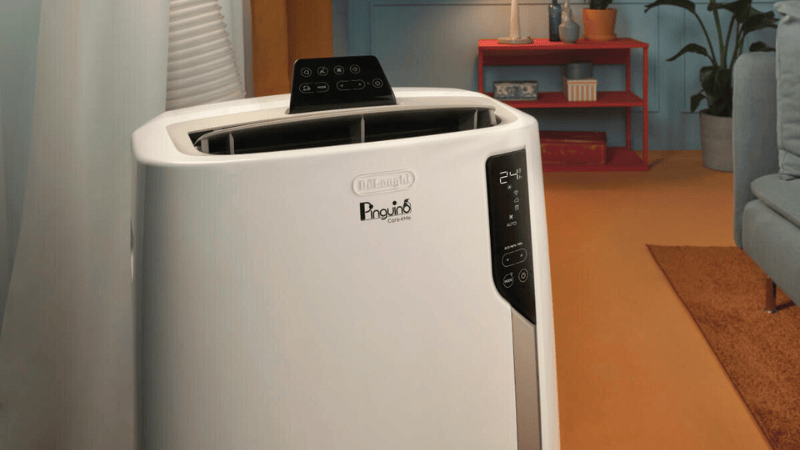
Australian summers can be intense, with temperatures ranging from 14.8°C to 31.9°C depending on the region. For many homes, an air conditioner is essential.
Portable air conditioners are a practical choice because they are easy to move, energy-efficient, simple to set up, and require no costly installation. In this guide, I’ve shortlisted the best options to help you stay cool this summer.
My Top Picks
My evaluation and research ended up with seven choices. But if you're short on time and need to make a quick purchase, here are my top three portable air conditioners for Aussies:
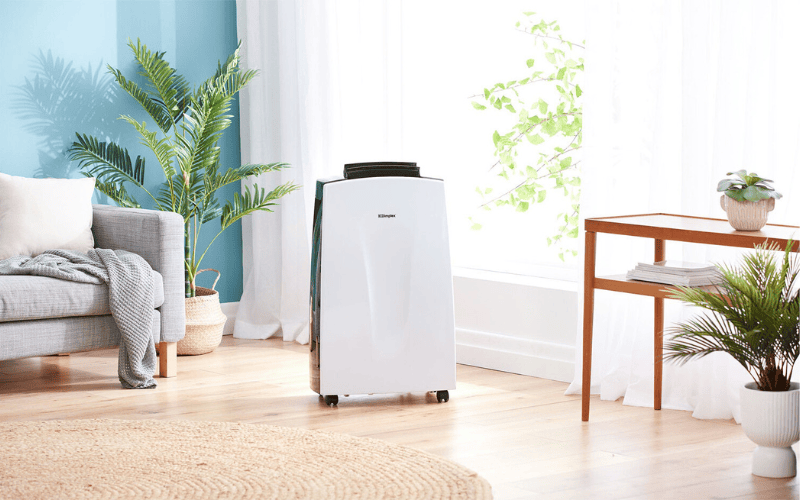
Dimplex DCP16C Portable AC
Best overall portable air conditioner with 15,354 BTU/h (4.5 kW) cooling capacity, dehumidifying function, LED display, remote control, and on/off timer.
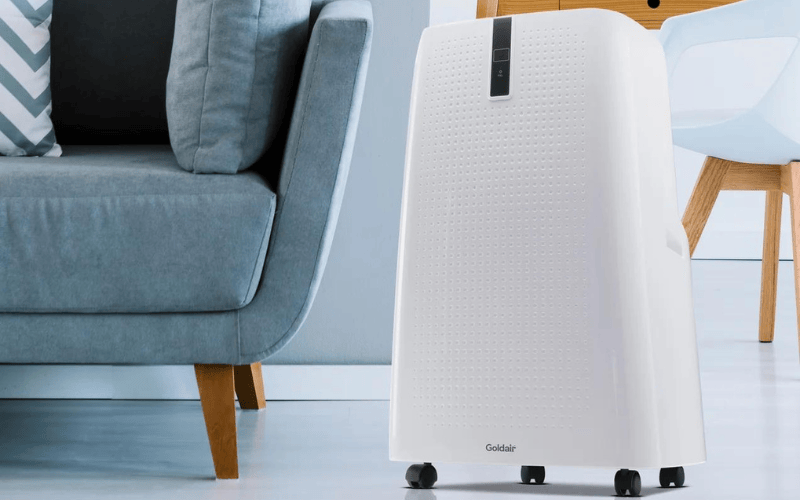
Goldair GCPAC350W Portable AC
Best smart, portable air conditioner with a 12,044 BTU/h (3.5 kW) cooling capacity, Wi-Fi connectivity, 3-in-1 functionality, and an adjustable thermostat.
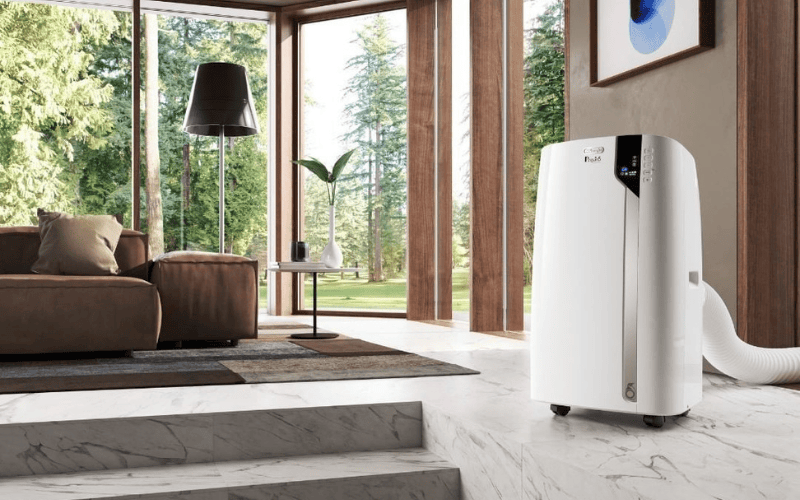
De’Longhi Pinguino Care4Me
Best multifunctional portable air conditioner with 11,000 BTU/h (2.9kW) cooling capacity, dehumidifying and fan-only functions, and temperature sensor.
Top 7 Portable Air Conditioners
Whether you’re looking for a portable AC for small rooms, large rooms, or even a model with multiple functions, here is a detailed breakdown of the best seven air conditioners to help you find the perfect fit for your needs and space.
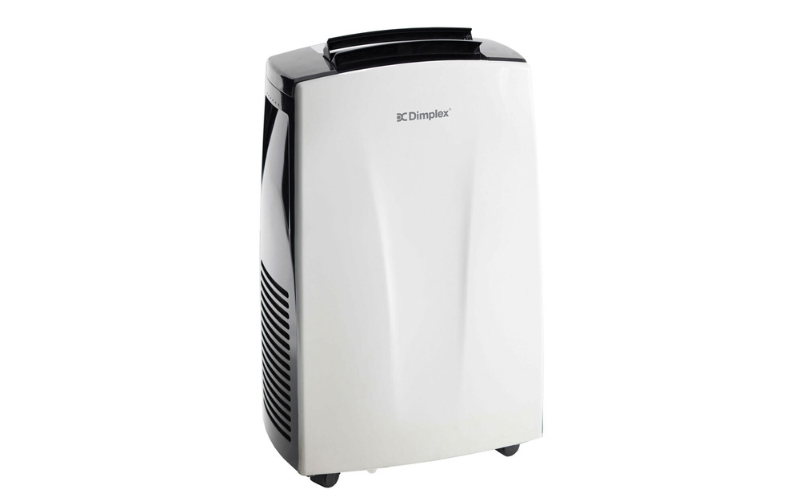
1. Dimplex DCP16C
Best Overall Portable Air Conditioner
Room size: 33 sqm
Noise level: 56 dB
The Dimplex DCP16C is easy to set up and has wheels, making it simple to roll from room to room, though you’ll still need to connect the exhaust hose to a nearby window, so positioning matters.
It can cool spaces up to 33 cubic metres and runs at a manageable noise level. You can control it with the remote, which has an LED display, or use the panel on top of the unit. From there, you can adjust the temperature, switch between cooling and dehumidifying, and choose from three fan speeds.
It also comes with a timer to help reduce energy use, washable filters to trap dust, pollen, and debris, and a self-evaporative system for excess moisture. Just note that you may still need to open the drain hole to empty condensed water from the tank.
Pros
- Cools up to 33m³
- Portable, no installation
- Self-evaporative, washable filters
- Built-in timer for scheduling
- Intuitive remote control
Cons
- Relatively noisy
- Manual louvre adjustment
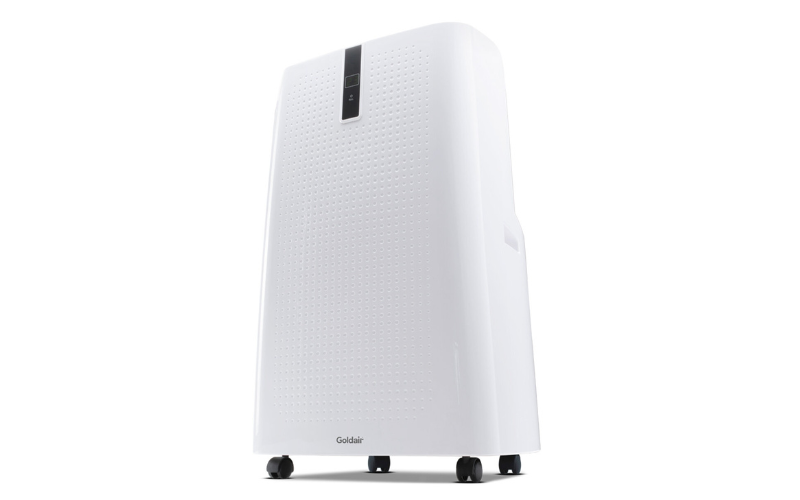
2. Goldair GCPAC350W
Best Smart Portable Air Conditioner
Dehumidifying capacity: 28 l/24
Noise level: 62 dB
The Goldair Portable Air Conditioner is a smart, versatile unit with Wi-Fi connectivity and three-in-one functionality. It works as an air conditioner, heater, and dehumidifier, making it a good pick if you don’t have space for separate appliances.
You can control it from anywhere using Wi-Fi, Alexa, or Google Assistant. It also has a digital display, electronic controls, and a remote for easy operation. Like the Dimplex DCP16C, it includes an on/off timer, so you can cool your room when needed and switch it off to save energy.
The adjustable thermostat helps keep the room at a steady, comfortable temperature, while the three fan speeds let you choose the cooling level that works best for your space.
Pros
- User-friendly controls and remote
- Dehumidifying, hot, and cold function
- Alexa and Google Assistant compatibility
- Adjustable thermostat for efficiency
- Smart Wi-Fi connectivity
Cons
- 62 dB noise level
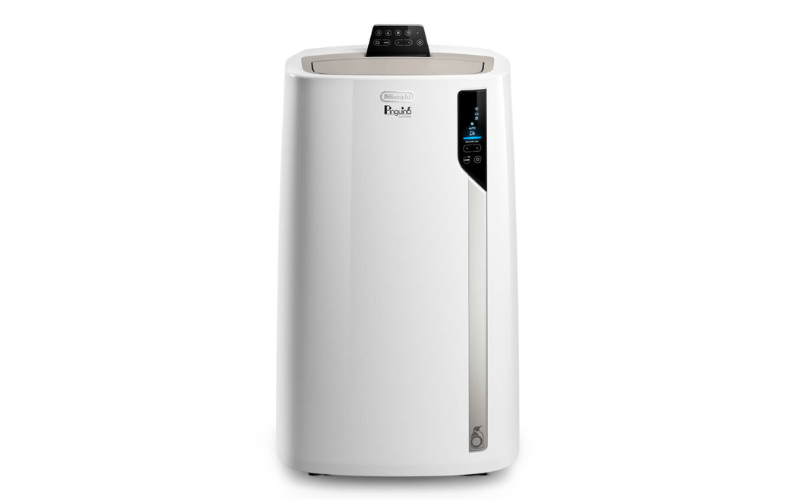
3. De’Longhi Pinguino Care4Me
Best 3-in-1 Portable Air Conditioner
Room size: Medium-sized
Noise level: 47 - 50 dB
The De’Longhi Pinguino Care4Me is a powerful air conditioner for efficient cooling, dehumidifying, and fan-only use. At 33 kg, it is still easy enough to move around, thanks to its sturdy handles and heavy-duty castors.
It delivers up to 11,000 BTU of cooling power and is suitable for spaces up to 110m³. One of its standout features is Cool Surround Technology, which uses the remote to monitor room temperature and humidity, then adjusts the settings automatically for better comfort and efficiency.
You can also control the unit through the display screen or the remote, which works up to 10 metres away. It includes settings for temperature, fan speed, silent mode, airflow, flap swing, timer, and eco mode. It is my top pick for the best balance of build quality, cooling power, dehumidifying performance, and energy efficiency.
Pros
- Sleek, portable design
- Efficient, energy-saving cooling
- Convenient remote control
- Intuitive display screen
Cons
- 63 dB noise level
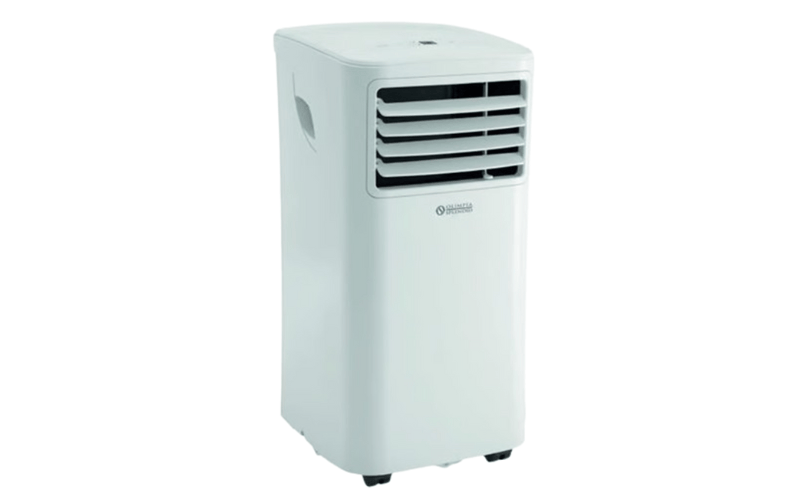
4. Olimpia Splendid COMPACT10AU
Best Portable Air Conditioner for Small Spaces
Room size: 20 sqm
Noise level: 47 - 52 dB
The Olimpia COMPACT10AU is for small spaces. It is lightweight, easy to move, and runs at a fairly quiet 47 to 52 dBA. It also comes with a window venting kit that is simple to install on sash and hung sash windows.
It is easy to use too. You can adjust the settings through the touchscreen display or use the remote to change the mode, temperature, and timer from your couch or bed. Like the Dimplex DCP16C, it cools and dehumidifies at the same time, helping improve efficiency and reduce energy use.
The dehumidifying function can also help reduce damp smells caused by mildew, mould, and excess moisture.
Pros
- Compact, lightweight design
- Auto mode for efficient cooling
- Easy touchscreen and remote control
- Has integrated handles and castors
- Quick setup with window kit
Cons
- Lacks advanced features
- No turbo fan, anti-dust filter
- Sleep mode, automatic louvres missing
- No eco mode
5. TECO Reverse Cycle
Best Reverse Cycle Portable Air Conditioner
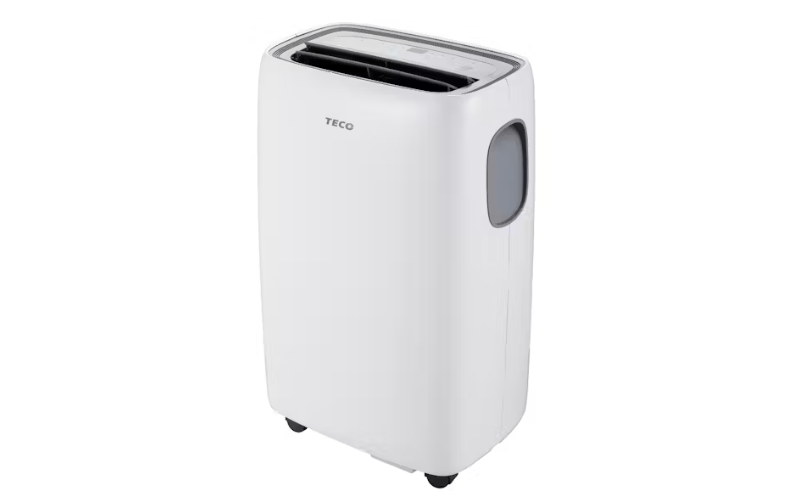
Dehumidifying capacity: 36 l/24
Room size: 30 sqm
Noise level: 64 dB
The TECO Portable Air Conditioner is a reverse-cycle unit, so it can cool your room in summer and warm it in cooler weather. It uses R290 refrigerant, which is more efficient and environmentally friendly, and its dehumidifying function can remove up to 1.5 litres of excess moisture from the air.
It is not the lightest model in this roundup, but its compact design and heavy-duty castors make it easy to move between rooms. It also comes with a window kit designed to fit common Australian window types, allowing hot air to vent outside while cooling.
You also get built-in Wi-Fi, so you can control the unit remotely through the TECO app and manage your cooling more efficiently.
Pros
- Innovative window kit
- Effective reverse cycle function
- Energy-efficient dehumidification
- Wi-Fi and remote control
- User-friendly features
Cons
- Relatively pricey
- Limited capacities for larger rooms
- 64 dB noise level
6. Rinnai RPC41MCWF
Best Portable Air Conditioner for Large Rooms
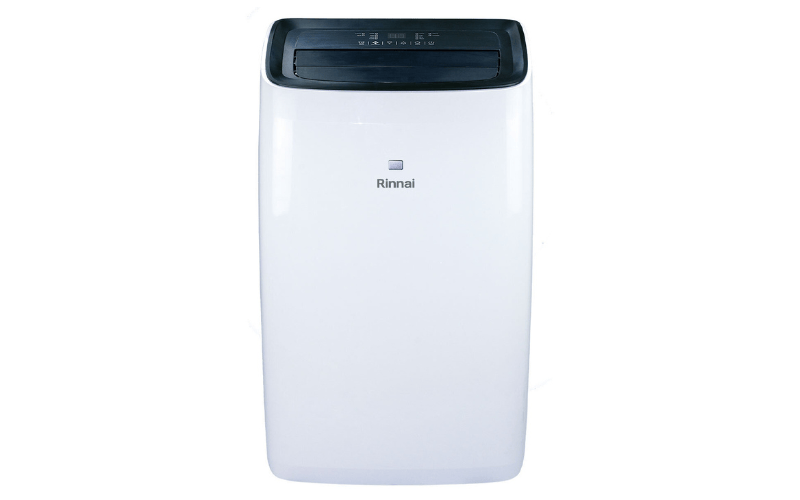
Room size: 30 sqm
Noise level: 65 dB
The Rinnai RPC41MCWF is a practical option for cooling larger rooms, including bedrooms and home offices. It is easy to control with the remote or the sleek control panel, where you can adjust settings, activate sleep mode, or set the built-in timer.
Its smart auto mode helps improve efficiency by switching to fan mode when the room is below 23°C and cooling mode when it rises above 23°C. It also has a dry mode for reducing excess moisture.
The self-evaporative system sends collected water out through the exhaust pipe, so you do not have to keep emptying the tray. The washable filters are also easy to remove and clean with a vacuum cleaner or a soft, damp cloth.
Pros
- Smart auto mode
- Easy operation with remote control
- Washable filters for easy cleaning
- Self-evaporative system
Cons
- Loud at highest fan speed
- No dehumidification function
7. YRIGHT FRKH-L14
Best Cheap Portable Air Conditioner
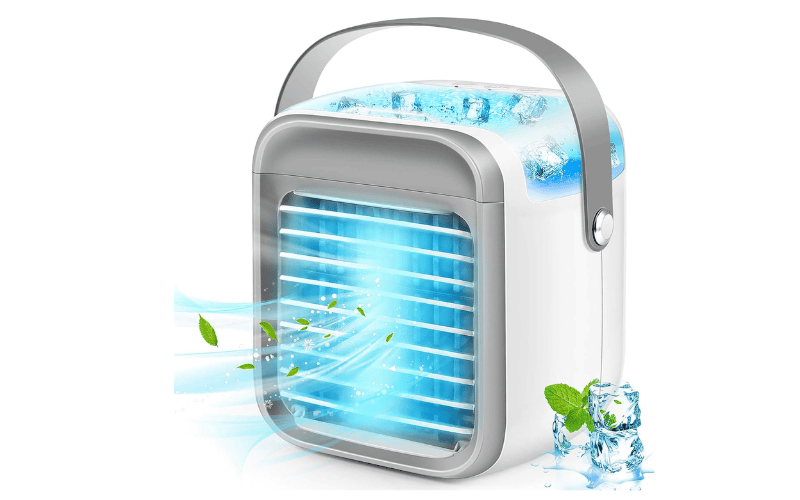
Tank capacity: 300 ml
Power source: Battery-Powered
The YRIGHT FRKH-L14 Air Cooler is an affordable air conditioner with evaporative technology. It has three unique functions: it serves as a personal air conditioner for cooling your home, has a fan mode to improve airflow, and humidifies your room's air.
Being a cordless appliance, the YRIGHT FRKH-L14 is also ideal if you want an extremely portable air-cooling system. You can place it anywhere in your home or even take it outdoors during picnics. It's rechargeable, with a 4 to 5-hour battery life. And the ability to charge it with a Type-C cable, car charger, or a power bank ensures that it's always ready for use.
YRIGHT's budget-friendly air cooler has a convenient tank capacity of around 300 ml. So you don’t have to worry about frequent refills. My only complaint is coverage—you won't feel the cool air more than 4 m away.
Pros
- Cordless design
- Rechargeable and energy-efficient
- Large tank for less frequent refills
- Multifunctional—AC, fan, humidifier
- Convenient charging options
Cons
- Limited coverage
How I Conducted Research
Portable air conditioners are ideal for households that need effective cooling without fixed installation. To find the best options, I compared models based on cooling performance, ease of use, energy consumption, value for money, and suitability for Australian homes.
I focused on key features such as BTU rating, energy efficiency, remote controls, programmable timers, and easy-to-clean filters. I also reviewed technical specs, customer feedback, hands-on performance, and expert insights on maintenance and durability.
The final shortlist highlights portable air conditioners that are reliable, convenient, and practical for everyday cooling.
How Does a Portable Air Conditioner Work?
The core function of a portable air conditioner is to transfer heat from the interior of a room to the outside. This process involves refrigeration cycles similar to those in standard air conditioning systems. I'll explain how the components work in unison to achieve this goal.
- Compressor: Pressurises refrigerant to release heat.
- Evaporator: Absorbs heat from the air.
- Condenser: Dispels the absorbed heat.
- Expansion Valve: Regulates refrigerant flow.
- Fan: Circulates air over the evaporator and condenser.
- Controls: Allow for temperature and mode adjustments.
Each component plays a vital role in the operation of a portable air conditioner. These appliances also rely on exhaust hoses to dispel the warm air that is generated during the cooling process.
Portable air conditioning units provide a convenient solution for cooling spaces where traditional and split-system air conditioners are impractical. Unlike fixed installations, these mobile units offer flexibility and adapt to a variety of settings, from homes to offices.
Types of Portable Air Conditioners
There are three different types of portable air conditioning units on the Australian market: single-hose, dual-hose, and evaporative.
Type #1 - Single-Hose
The most popular portable air conditioning units have a single-hose design. They pull in warm air, use mechanical means to cool it, and then release the cooled air back into the room through top or front louvres.
The excess heat in the machine is expelled outdoors through the single hose, which is attached to the back of the unit. However, the single hose doesn’t draw enough air from the outside to cool the heated components in the machine. So, the machine resorts to drawing more air from the room to cool its internal components, which causes negative pressure to build up in the room.
If you don’t properly seal the window or any other openings, air from outside will force its way in at a higher rate. Consequently, the machine works extra hard to cool the excess air.
Type #2 - Dual-Hose
Portable air conditioners with a dual-hose design pull in warm air from the room, cool it and distribute it back into the room. However, thanks to the dual-hose design, they don’t pull air from the room to cool the internal components. You have an intake and exhaust hose at the back of the unit.
The exhaust hose is the usual venting pipe that comes with single-hose ACs, and its main function is to expel heat outside. The intake hose draws in air from the outside to help cool down the mechanical components in the machine. The excess air in this pipe helps draw in prevents negative pressure since the machine doesn’t have to pull air from the room.
So, dual-hose AC units usually have a superior energy efficiency rating than single-hose units. I often recommend them for larger rooms, but they are also often more expensive than other types.
Type #3 - Evaporative
Evaporative portable air coolers do not have a condenser or compressor like traditional air conditioners. Instead, they use the process of evaporation to cool the air. Water is poured into the cooler and then evaporates, which cools the air being blown out by the fan.
These coolers do not require venting hoses because they do not have internal mechanical components that generate heat and need cooling. This makes them truly portable, as they do not need to be connected to a window kit. They are most effective in areas with low humidity.
However, it's important to note that while evaporative coolers can help cool the air, they may not be as effective as traditional air conditioners in very humid environments or for cooling large spaces. They are a more energy-efficient option and are best suited for hot, dry climates.
How to Compare Portable Air Conditioners?
To choose the best portable air conditioner for your cooling needs, here are seven factors to consider.
#1 - Room Size
Room size is the first thing to check. If the portable air conditioner is too small, it will struggle to cool the room. If it is too large, it may cool the space too quickly without properly removing moisture from the air.
Cooling capacity is measured in BTUs per hour. A simple rule is to allow about 20 BTUs for every square foot of floor space. So, for a 400ft² room, you would need around 8,000 BTUs.
#2 - Energy Efficiency
You do not want a portable AC that sends your electricity bills up, so check the energy rating before buying. You’ll find it on the unit’s energy label. Standard portable ACs usually show a blue star rating for cooling, while reverse-cycle models show both a blue star for cooling and a red star for heating.
Energy ratings usually range from A++ to E, with A++ being the most efficient. Aim for a model rated A or higher, though a B-rated unit can still be reasonable depending on its price and features.
#3 - Noise Level
Noise level matters, especially if you plan to use your portable AC at night. Some models can be loud on full power, while others are much easier to live with. Most portable ACs list a noise rating on the product page, usually between 50 and 75 dB.
It’s best to test the unit in person before buying, but that is not always possible online. In that case, check customer reviews and forums to get a clearer idea of how noisy the unit is in real use.
#4 - Operating Modes
Most people buy portable air conditioners for cooling, but many models do more than that. The best options can dehumidify, improve airflow, and in some cases, heat the room through reverse-cycle technology.
Some models also include smart and energy-saving modes that adjust performance based on the room temperature. Higher-end units may offer Wi-Fi or Bluetooth connectivity, so you can control the AC remotely for added convenience.
#5 - Controls
Check how easy the portable AC is to control. Basic models usually have only a control panel, so you need to operate them manually. Newer models often include a remote control and app connectivity, making it easier to adjust settings from your couch or bed.
I recommend a unit with clear LED controls and well-labelled buttons, so changing the temperature, mode, or timer is simple.
#6 - Louvre Design
Portable ACs may come with manually adjustable, fixed, or automatic louvres. Of the three, automatic louvres are the most convenient for effective cooling, airflow, and dehumidification. While at it, consider the layout of your room and the position of the louvres on the machine.
#7 - Easy Setup and Portability
All portable air conditioners except evaporative air coolers have a venting system for expelling hot air outside. The hose is usually attached to a window or door kit. Make sure the model you’re getting comes with a kit that’s compatible with your window or door for ease of use.
Likewise, the best portable air conditioners have integrated handles for lifting and easy-rolling castors to move the unit from one point to another. If you intend to move your air conditioner frequently, then consider the weight of the machine alongside these features.
Frequently Asked Questions (FAQs)
Here are some frequently asked questions about portable air conditioners in Australia.
What is a good size portable air conditioning unit?
A good size for a portable air conditioning unit often depends on the size of the room it will be used. For small rooms, such as a single bedroom or living room area, a unit with a cooling capacity between 7,000 and 10,000 BTUs is often sufficient. However, as the space increases, so does the cooling power you'll need to maintain a comfortable temperature.
What is the best alternative to air conditioning?
The best alternatives to air conditioning include:
- Evaporative coolers or swamp coolers: These use water to cool the air.
- Powerful fans: Room or whole house fans can circulate air to create a breeze in your room.
- Solar cooling: This uses the sun's energy to cool your home.
- Geothermal heating and cooling: This uses the earth's temperature to regulate your home's temperature.
- Attic fan: Attic fans draw hot air out of your attic and lower the temperature of your home.
- UV-reflective window film, thermal curtains, or plants: These block or reduce the heat from the sun.
Each of these alternatives offers unique benefits, including cost-effectiveness and temperature-lowering power. However, the effectiveness of each alternative can depend on various factors, such as the climate where you live, the size of your home, and your specific cooling needs.
Wrapping Up
While portable air conditioners are appealing on hot summer days, they are not necessarily a cure-all appliance, nor are they exactly portable since you have to hook them to a window to vent hot air outside.
So, make sure your selection process is thorough. Consider every little aspect, including your room size, energy efficiency, capacity, noise, operating modes, controls, and unique features, to ensure you have the right pick for your cooling needs and requirements.






)