
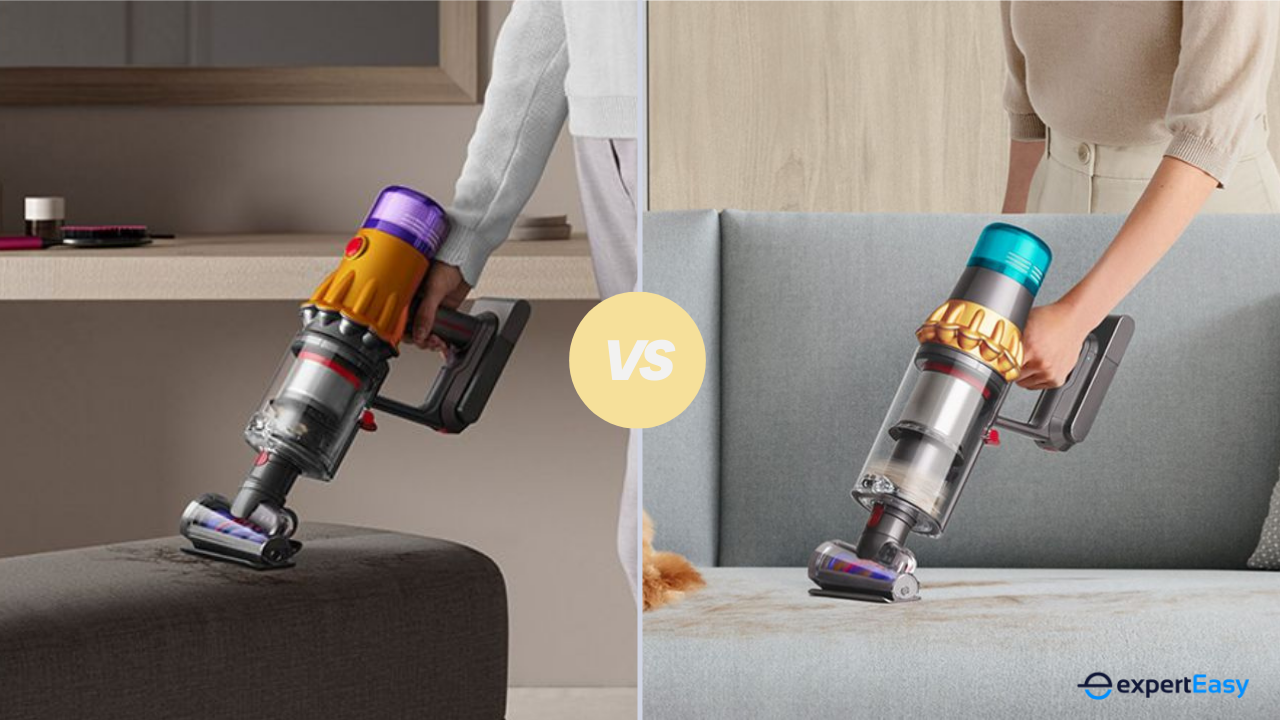
Two of Dyson's newer vacuums are the V12 and V15. The V15 was released in 2021, and the V12, which I'll classify as a mini version of the V15, was released in 2022 with impressive new features.
To help you choose, I present the results of four cleaning and usability tests comparing both models in this detailed guide.
What is the Dyson V12 Vacuum?
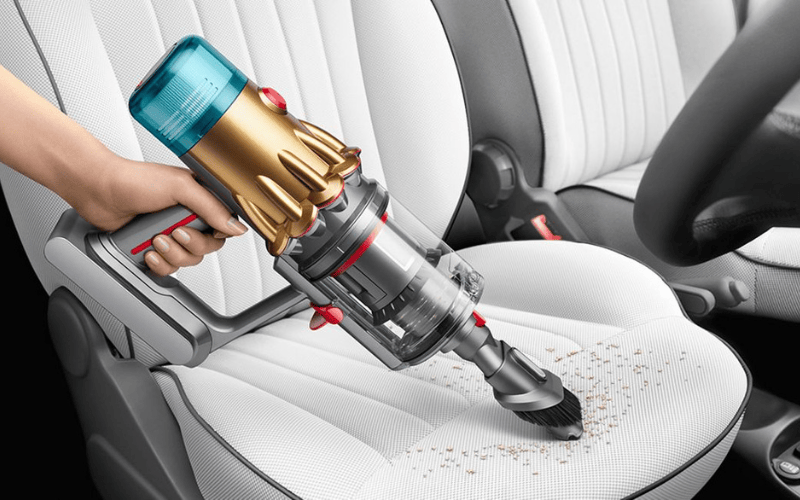
The Dyson V12 is Dyson's lightest intelligent cordless stick vacuum. It's built for easy manoeuvrability so you can clean under furniture, around corners, and on elevated surfaces with ease.
Its features include a Laser Slim cleaner head, which reveals invisible dust during cleaning, and the Piezo sensor, which automatically adjusts suction power based on the size of detected dust particles.
The vacuum cleaner also has a convenient power button, a click-in battery pack, point-and-shoot dirt ejection, an LCD, and a unique set of attachments.
What is the Dyson V15 Vacuum?
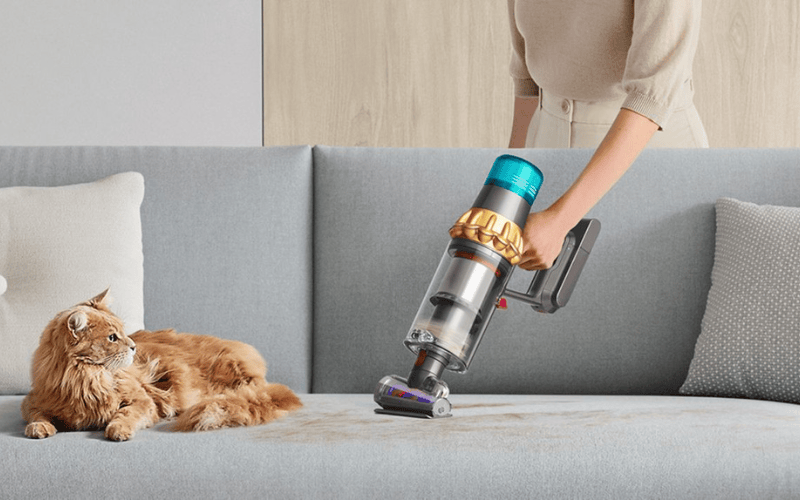
The Dyson V15 stick cordless vacuum is for large homes with pets. It has strong suction with a sensor and DLS technology, which assesses the level of debris and auto-adjusts to the right amount of suction power.
Dyson’s V15 has an LCD that calculates and categorises debris types you are cleaning from the floor. The display also shows the power mode you are using and a runtime countdown to know when to recharge the battery. And like the V12, the V15 also has a laser cleaner head.
Dyson V12 vs. V15: Specifications
Here's a comparison of the key specifications between the Dyson V12 and V15 to help you quickly understand their core differences.
| Feature | Dyson V12 | Dyson V15 |
|---|---|---|
| Dimensions | 126.4 x 25.2 x 25 | 126 x 26.6 x 25 |
| Weight | 2.2 kg | 3.1 kg |
| Dustbin | 0.35 L | 0.77 L |
| Suction | 150 AW | 240 AW |
| Battery | 60 mins | 60 mins |
| Recharge | 3.5 hours | 4.5 hours |
| Noise | 82 dB | 78 dB |
| Filtration | Whole-machine HEPA filtration | Whole-machine filtration |
| Warranty | Two years | Two years |
At a glance, the V12 and V15 offer a bagless design and similar dimensions, but they differ in other key areas.
The V15 is heavier (3.1 kg) than the V12 (2.2 kg) and includes a larger dustbin capacity, i.e., 0.77 L vs. 0.35 L. And with a suction power of 240 AW, the V15 vacuum also outperforms V12's 150 AW.
Both models offer a battery life of 60 minutes, but the V15 takes an hour longer to recharge. For noise levels, the V15 is quieter at 78 dB than the V12's 82 dB. You get comprehensive accessories for each model, including a Motorbar, a fluffy cleaner head, and wall-mountable docks.
Dyson V12 vs. V15: Tests & Comparisons
The summaries above provide a good snapshot of each vacuum's offerings. Read on to learn more.
Design and features
The V12 and V15 have Dyson’s latest technology, including a laser slim brush roll, torque screw tool, and piezo sensor. The V12 looks more like a refresh of the V15 with a push power button. However, there are still some significant design differences.
#1 - Vacuum and motor size
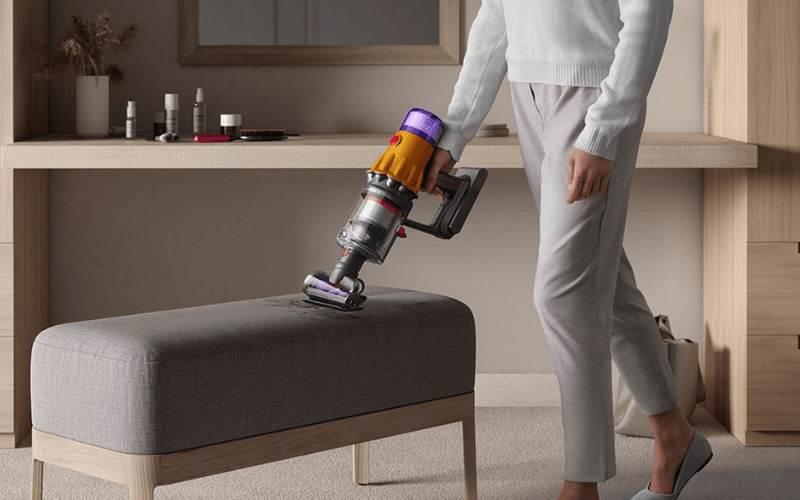
The Dyson V15 is visibly larger than the V12 because it has a larger dust bin, motor, and an upgraded battery pack.
In contrast, the Dyson V12 is lighter by 0.9 kg and has a more ergonomic frame. So, if you want a vacuum that’s easier to manoeuvre and carry, the V12 is the better choice. At the same time, the V15 offers more power and capacity for those who prioritise performance over weight.
Speaking of performance, the Dyson V12 has a smaller motor than the V15. This design difference affects its suction power by around 90 air watts at the maximum power setting compared to the V15 vacuum. This difference is noticeable in my deep cleaning tests below.
#2 - Controls and battery life
The Dyson V12 Detect Slim has a push power button for convenience and manoeuvrability, so you can swap hands while vacuuming. For the V15, you get Dyson's traditional trigger power button, which requires holding down the trigger to keep the vacuum running.
While I recommend the V12's user-friendly design that reduces hand fatigue and allows for easier operation, it’s still a tough choice. A good user experience is essential for prolonged cleaning sessions, but so is the battery life. And the V12 vacuum falls short of the latter.
You get a capacity of 2500 mAh on the V12 vacuum, whereas the Dyson V15 vacuum has a capacity of 3600 mAh. For light cleaning on Eco or energy-efficient mode, you get at least 60 minutes from either cleaner, but the V15 performs for longer periods in auto and boost modes.
#3 - Accessories and attachments
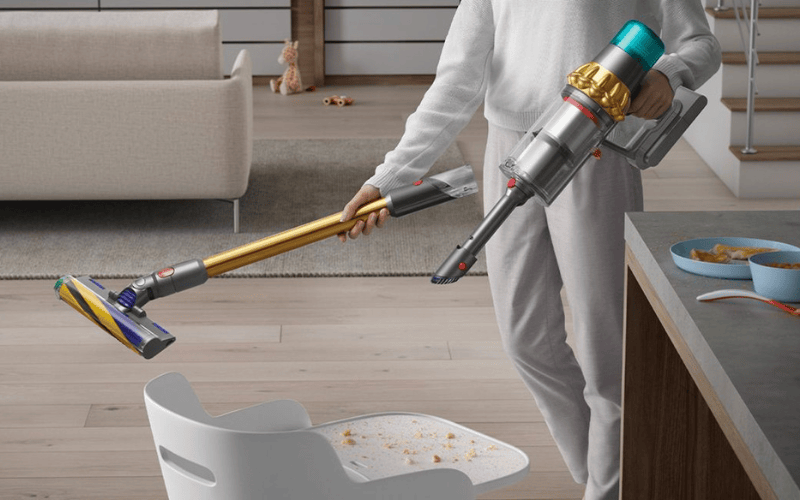
The Dyson V15 and V12 use similar tools but aren’t all interchangeable because the V12 has a smaller attachment port than the V15.
Both vacuums have a standard brush roll nozzle, but the V15’s brush has combs and adjustable gates, while the V12 uses a brush roll similar to that of the Dyson V8 but with more ports for picking large debris piles. Additionally, the V15 has a larger dust bin capacity of 0.77 L, almost twice that of the V12 of 0.35 L. Thus, the V15 is more suitable for cleaning larger areas.
If you’re deciding based on accessories and compatibility with other models, choose the Dyson V15 for its extensive set of tools and attachments. It’s also compatible with non-powered attachments from other Dyson V-series vacuums, such as the V7, V8, V10, V11, and V12.
Performance and usability tests
I used the Dyson V12 Detect Slim Complete and the Dyson V15 Detect Absolute in the cleaning and usability tests below. Here are the four tests I conducted, and which vacuum cleaner came out on top:
#1 - Cleaning
I tested both vacuums on hard surfaces (like laminate and tile) and carpet types (low-pile and high-pile). The V15's advanced features, including its high-torque and laser dust detection, provided better results on hard floors.
| Dyson V12 | Dyson V15 | |
|---|---|---|
| Hardfloor | 9.5 | 10 |
| Low-pile carpet | 9.0 | 9.5 |
| High-pile carpet | 8.9 | 9.5 |
| Overall | 9.1 | 9.7 |
The Dyson V12 has a maximum suction power of 150 AW, while the Dyson V15 boasts a significantly higher suction power of 240 AW.
This increased power allows the V15 to perform better on carpets and tackle larger debris more effectively. It's particularly effective for deep cleaning carpets, requiring fewer passes than the V12.
During my tests, the V15 achieved a cleaning efficiency of 9.7, outperforming the V12, which had a cleaning efficiency of 9.1. So, while both are high-performing cordless vacuums, the V15 stands out with regard to suction power and cleaning efficiency, making it a better choice.
#2 - Run time tests
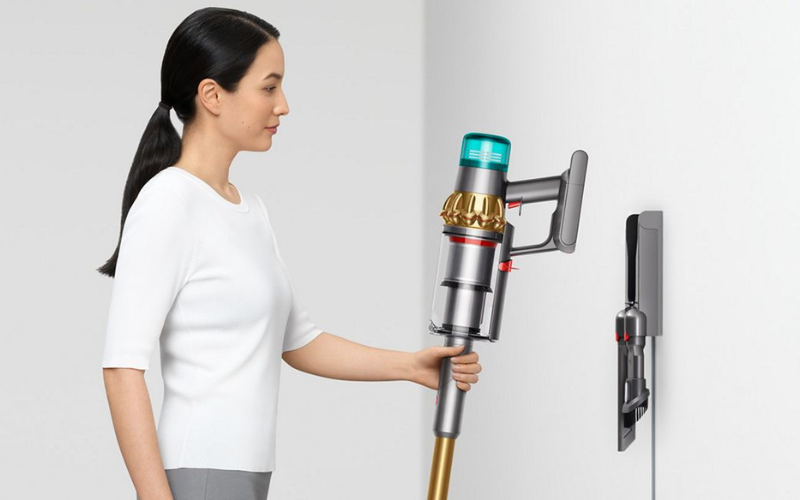
The V12 and V15 vacuum cleaners are designed to provide up to 60 minutes of run time on a fully charged battery. However, there are slight differences in performance and efficiency in real-life use cases.
For instance, the Dyson V12 often runs for about 51 minutes in Eco mode when cleaning hard floors and around 36 minutes in Medium/Auto mode. In Boost mode, it lasts about 7 minutes.
The V15, on the other hand, runs for about 69 minutes in Eco mode, which is longer than the V12. In Medium/Auto mode, it lasts around 45 minutes and operates for about 9 minutes in Boost mode.
Here’s a summary of the run times I recorded:
| Mode | Dyson V12 | Dyson V15 |
|---|---|---|
| Eco | 51 mins | 69 mins |
| Medium / Auto | 36 mins | 45 mins |
| Boost | 7 mins | 9 mins |
It's evident that the Dyson V15's enhanced battery capacity and suction power contribute to its performance. Fortunately, both vacuums use a click-in battery, so you can purchase additional batteries to extend the battery life of the cleaner during prolonged cleaning sessions.
#3 - Motor tests
Here’s an overview based on the results of the motor tests:
- Suction power: The V12 showed about 82% of the suction power of the V15, indicating strong performance, especially for its lighter weight.
- Airflow metrics: While the V12 has 72 inches of suction and 29 cfm of airflow, the V15 offers 92 inches of suction and 57 cfm of airflow.
Both vacuum cleaners use Dyson’s Hyperdymium motor that spins up to 125,000 RPM. However, when in use, the V15 outperforms the V12 in suction power, airflow, and deep cleaning capabilities.
#4 - Ease of use
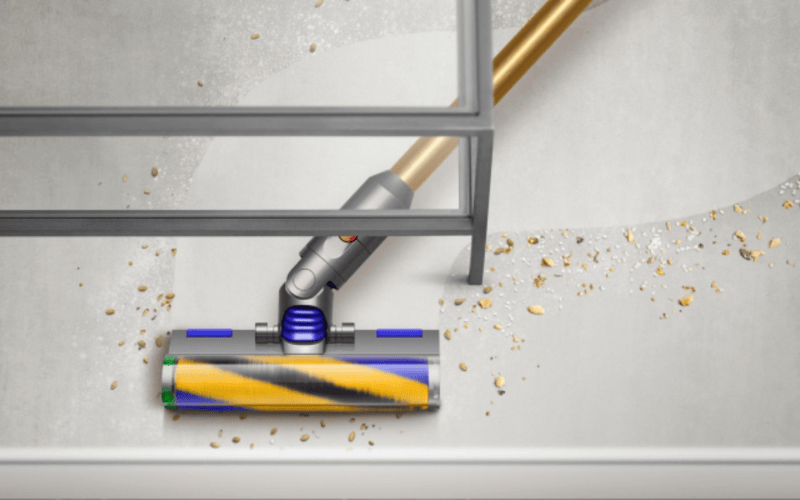
I recommend the Dyson V12 between the two models as it has many small yet significant changes that impact its overall convenience.
For starters, it weighs less than the V15. This makes it easier to carry around, especially for cleaning stairs or reaching high places. That aside, unlike the V15, the V12 has a push-button power control instead of holding down a trigger, allowing for a more comfortable experience.
Both vacuum cleaners have a dustbin emptying mechanism that minimises mess while keeping your hands clean. The V12 falls behind the V15 when comparing the dustbin capacity. You get 0.35 litres, requiring more frequent emptying during cleaning sessions, compared to the V15’s 0.77 litres.
Here’s a summary of my tests and other vital factors to consider if you decide solely based on ease of use and convenience.
| Feature | Dyson V12 | Dyson V15 |
|---|---|---|
| Weight | 2.2 kg | 3.1 kg |
| Power control | Push button | Trigger |
| Dustbin capacity | 0.35 L | 0.77 L |
| Emptying mechanism | Easy, no-touch | Easy, no-touch |
| Runtime | 51 mins | 69 mins |
Price comparisons
For consumers in Australia, the Dyson V12 is currently priced at $1,349.00, a drop from $1,239.00, for an 8% discount on their storefront and website. The V15 costs $1,499.00, with no promo available.
Dyson V15's price reflects its advanced features and capabilities. If you're considering which model to purchase, it's essential to weigh the price against the specific features and performance.
Which Vacuum is Better?
| Dyson V12 | Dyson V15 | |
|---|---|---|
| Cleaning | ✔️ | |
| Run time tests | ✔️ | |
| Motor tests | ✔️ | |
| Ease of use | ✔️ |
The Dyson V15 vacuum cleaner won in three of my four cleaning and usability tests, making it the overall champion in this comparison.
However, your final choice should be based on your budget, the types of surfaces and how often you need to clean, the size of your home, ease of use or convenience, and whether or not you have pets.
If you’re looking for a more budget-friendly option, the Dyson V12 is a solid alternative, though it doesn't perform as well on carpets due to its lower suction power compared to the Dyson V15.
Frequently Asked Questions
We answered some frequently asked questions:
Does the Dyson V12 mop?
Yes, the Dyson V12 can mop, but it requires an additional attachment.
Is it OK to leave Dyson vacuum on charge?
Yes, it is generally safe to leave your Dyson vacuum on charge. Dyson's intelligent control software ensures that the vacuum only draws enough power to recharge and maintain its battery, preventing overcharging. However, for optimal battery health, it's advisable to unplug the charger if the vacuum will not be used for an extended period.
What is the lifespan of a Dyson vacuum?
The lifespan of a Dyson vacuum is 10 years, depending on usage and maintenance. While the vacuum can last this long, the battery requires replacement every 4 to 5 years to maintain optimal performance. Regular maintenance will also help extend the overall life of the vacuum.
How often to clean the Dyson vacuum?
For optimal performance, clean your Dyson vacuum every two months. However, if you use your vacuum frequently or have pets, you may need to clean it more often.
Key maintenance tasks include
- emptying the dustbin before it reaches the MAX mark;
- washing the filter at least once a month;
- regularly checking and cleaning the brush bar to prevent clogs.
These cleaning routines ensure your vacuum operates efficiently and prolongs its lifespan.
 Laura Kemp
Final Thoughts
Both vacuum cleaners showcase impressive features tailored to meet different cleaning needs. The Dyson V12 vacuum is lightweight and easy to handle, making it an excellent choice for quick clean-ups and smaller spaces.
On the other hand, the Dyson V15 vacuum offers more performance with advanced features, larger dustbin capacity, and longer runtime, making it ideal for larger homes or more demanding cleaning tasks.





)
)
)